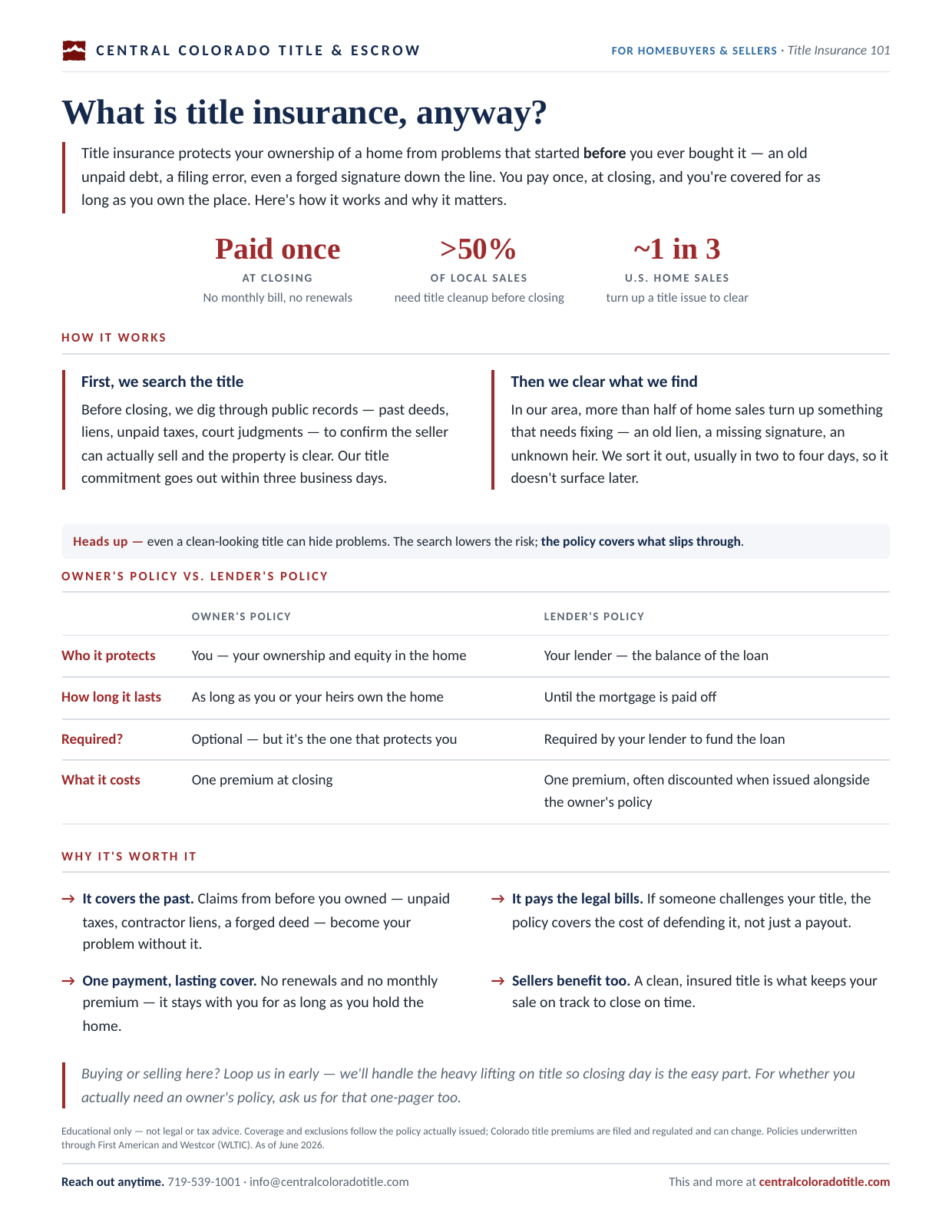
Title insurance protects your ownership from problems that started before you ever bought the home — an old unpaid debt, a filing error, even a forged signature down the line. You pay once, at closing, and you’re covered for as long as you own the place. Here’s how it works and why it matters.
How it works
- First, we search the titleBefore closing, we dig through public records — past deeds, liens, unpaid taxes, court judgments — to confirm the seller can actually sell and the property is clear. Our title commitment goes out within three business days.
- Then we clear what we findIn our area, more than half of home sales turn up something that needs fixing — an old lien, a missing signature, an unknown heir. We sort it out, usually in two to four days, so it doesn’t surface later.
Heads up — even a clean-looking title can hide problems. The search lowers the risk; the policy covers what slips through. Roughly one in three U.S. home sales turns up a title issue to clear.
Owner’s policy vs. lender’s policy
- Owner’s policyProtects you — your ownership and equity. Lasts as long as you or your heirs own the home. Optional, but it’s the one that protects you. One premium at closing.
- Lender’s policyProtects your lender — the loan balance. Lasts until the mortgage is paid off. Required by your lender to fund the loan. One premium, at the filed simultaneous-issue rate when it’s issued alongside the owner’s policy.
Why it’s worth it
- It covers the past. Claims from before you owned — unpaid taxes, contractor liens, a forged deed — become your problem without it.
- It pays the legal bills. If someone challenges your title, the policy covers the cost of defending it, not just a payout.
- One payment, lasting cover. No renewals and no monthly premium — it stays with you for as long as you hold the home.
- Sellers benefit too. A clean, insured title is what keeps your sale on track to close on time.
Common questions
How much does title insurance cost, and how often do I pay?
One premium at closing — no monthly bill and no renewals. Colorado title premiums are filed and regulated, and the coverage lasts for as long as you own the home.
Isn’t the title search enough on its own?
The search lowers the risk, but it can’t catch everything — a forged signature, an unknown heir, or a filing error can surface later. The policy covers what slips through. In our area, more than half of sales turn up something that needs clearing before closing.
Do I need an owner’s policy if my lender already requires one?
Your lender’s policy only protects the bank’s loan balance. The owner’s policy is the one that protects your ownership and equity — it’s optional, but it’s the one that protects you. Ask us for the owner’s-policy guide for the full picture.
Educational only — not legal or tax advice. Coverage and exclusions follow the policy actually issued; Colorado title premiums are filed and regulated and can change. Policies underwritten through First American and Westcor (WLTIC). As of June 2026.