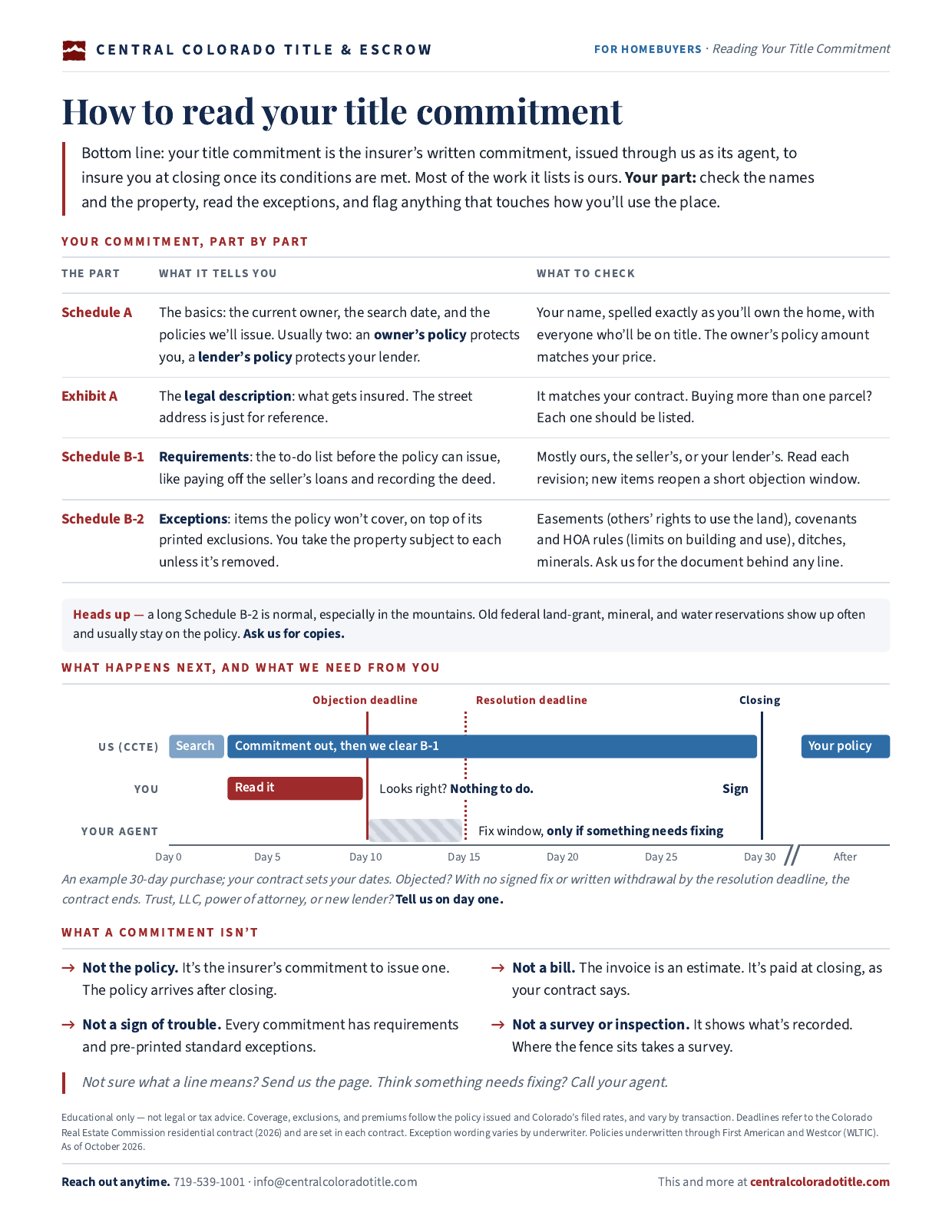
Your title commitment is the insurer’s written commitment, issued through us as its agent, to insure you at closing once its conditions are met. Most of the work it lists is ours. Your part: check the names and the property, read the exceptions, and flag anything that touches how you’ll use the place.
Bottom line: your title commitment is the insurer’s written commitment, issued through us as its agent, to insure you at closing once its conditions are met. Most of the work it lists is ours. Your part: check the names and the property, read the exceptions, and flag anything that touches how you’ll use the place. If everything looks right, you don’t need to do anything.
| The part | What it tells you | What to check |
|---|---|---|
| Schedule A | The basics: the current owner, the search date, and the policies we’ll issue. Usually two: an owner’s policy protects you, a lender’s policy protects your lender. | Your name, spelled exactly as you’ll own the home, with everyone who’ll be on title. The owner’s policy amount matches your price. |
| Exhibit A | The legal description: what gets insured. The street address is just for reference. | It matches your contract. Buying more than one parcel? Each one should be listed. |
| Schedule B-1 | Requirements: the to-do list before the policy can issue, like paying off the seller’s loans and recording the deed. | Mostly ours, the seller’s, or your lender’s. Read each revision; new items reopen a short objection window. |
| Schedule B-2 | Exceptions: items the policy won’t cover, on top of its printed exclusions. You take the property subject to each unless it’s removed. | Easements (others’ rights to use the land), covenants and HOA rules (limits on building and use), ditches, minerals. Ask us for the document behind any line. |
Read it the day it arrives. Check that your name, the property, and the policy amount match your contract, and look over the exceptions in Schedule B-2. If everything looks right, you don’t need to do anything. If something looks off, tell your agent before your Record Title Objection Deadline.
No. It’s an estimate of the title premium and related charges. Nothing is due now. It’s collected at closing, and your purchase contract decides who pays which part.
Much of central Colorado was first deeded by the federal government, and those original grants often kept rights to minerals, ditches, or water. Later owners also sold off mineral or water rights separately. These items usually stay on the policy. Ask us for copies of the documents behind them.
Call us for a copy of the document behind any line. If you think something needs fixing, call your agent. They track your contract deadlines and send any objection to the seller in writing.
Educational only — not legal or tax advice. Coverage, exclusions, and premiums follow the policy issued and Colorado’s filed rates, and vary by transaction. Deadlines refer to the Colorado Real Estate Commission residential contract (2026) and are set in each contract. Exception wording varies by underwriter. Policies underwritten through First American and Westcor (WLTIC). As of October 2026.