When a property already carries a qualifying title policy, the new policy is written at a percentage of the standard premium instead of the full amount. Ask your borrower for the prior policy and we will apply it.
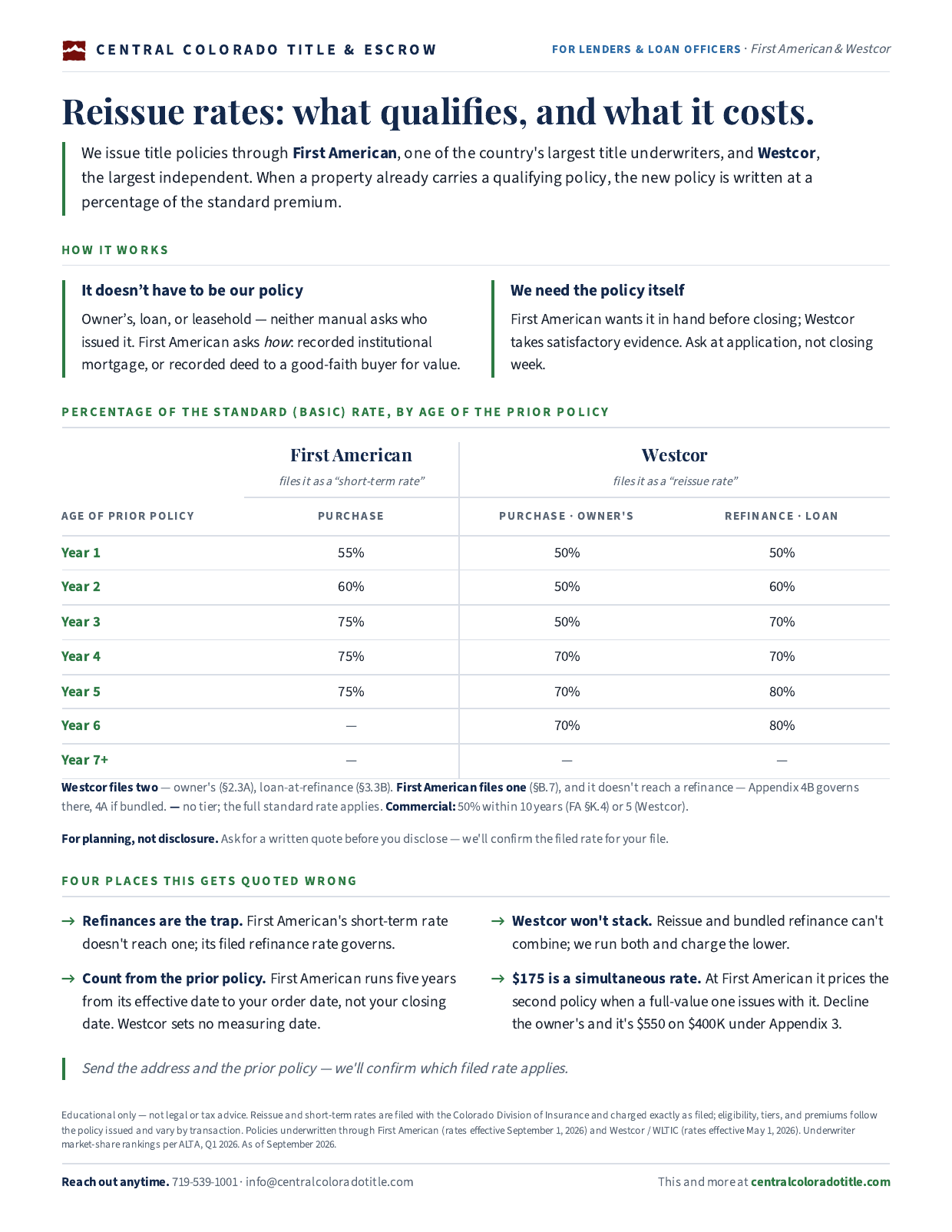
We issue title policies through First American, one of the country’s largest title underwriters, and Westcor, the largest independent. Both file a rate for property that already carries a qualifying policy. First American files it as a “short-term rate”; Westcor files it as a “reissue rate.” The idea is the same — the new policy costs a percentage of the standard (basic) premium rather than all of it.
| Age of prior policy | First American | Westcor | |
|---|---|---|---|
| Purchase | Purchase · owner’s | Refinance · loan | |
| Year 1 | 55% | 50% | 50% |
| Year 2 | 60% | 50% | 60% |
| Year 3 | 75% | 50% | 70% |
| Year 4 | 75% | 70% | 70% |
| Year 5 | 75% | 70% | 80% |
| Year 6 | — | 70% | 80% |
| Year 7+ | — | — | — |
— no tier; the full standard rate applies. Westcor files two rates — one on the owner’s policy, a separate one on the loan policy at refinance. First American files one, covering the owner’s, leasehold or loan policy — but it does not reach refinances, where Appendix 4B governs (4A if the loan policy is bundled). Commercial: 50% within 10 years at First American, 5 years at Westcor. Tiers reflect the filed manuals effective September 1, 2026 (First American) and May 1, 2026 (Westcor) — for planning, not disclosure. Ask us for a written quote before you disclose.
A filed rate that applies when the property being insured already carries a qualifying title policy. Instead of paying 100% of the standard (basic) premium, the new policy is written at a percentage of it — between 50% and 80%, depending on how old the prior policy is and which underwriter issues the new one. In Colorado every one of these rates is filed with the Division of Insurance and charged exactly as filed.
No. Neither filed manual conditions the rate on who issued the prior policy, and an owner’s, loan, or leasehold policy all count. First American does condition it on how the prior policy was issued: in conjunction with a recorded mortgage to an institutional lender, or a recorded deed to a bona fide — good-faith — purchaser for value. An ordinary purchase or refinance clears that; a quitclaim between family members does not. Either way you need to produce a copy of the policy.
At Westcor, yes — it files a separate reissue rate for the loan policy on a refinance, reaching back six years. At First American, no: its short-term rate expressly does not apply to a refinance, and its filed refinance rate governs instead. This is the single most common place a refi gets quoted wrong.
Yes, and by more than most people expect. The $175 lender’s policy is a simultaneous-issue rate — it exists because a full-value policy is being issued alongside it. With no owner’s policy, First American charges 100% of its Appendix 3 schedule instead: $550 on a $400,000 loan. Worth raising with the borrower before they decline.
First American reaches five years on a residential purchase and ten years on a commercial file. Westcor reaches six years on the owner’s side and six on a refinance loan policy, and five years commercially. So a six-year-old policy is still worth something at Westcor and nothing at First American.
The property address and a copy of the prior title policy. We will price the file under each underwriter’s filed manual and tell you which rate applies. You do not need to open an order first.
Educational only — not legal or tax advice. Reissue and short-term rates are filed with the Colorado Division of Insurance and charged exactly as filed; eligibility, tiers, and premiums follow the policy issued and vary by transaction. Figures are for planning, not for disclosure — request a written quote before disclosing. Policies underwritten through First American (rates effective September 1, 2026) and Westcor / WLTIC (rates effective May 1, 2026). Underwriter market-share rankings per ALTA, Q1 2026. As of September 2026.