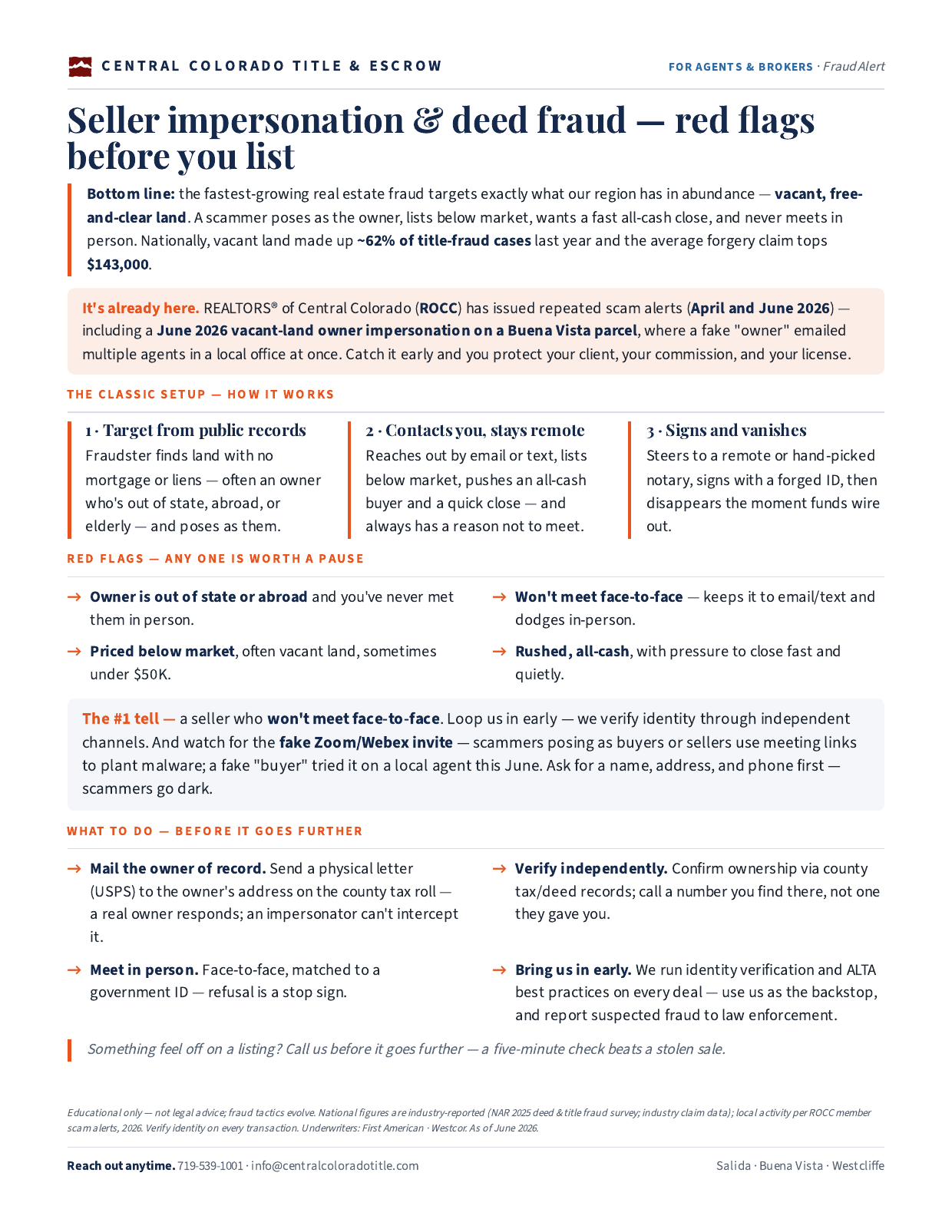
The fastest-growing real estate fraud targets exactly what Central Colorado has in abundance — vacant, free-and-clear land. A scammer poses as the owner, lists below market, wants a fast all-cash close, and never meets in person. Nationally, vacant land made up about 62% of title-fraud cases last year, and the average forgery claim tops $143,000.
It’s already here. REALTORS® of Central Colorado (ROCC) issued repeated scam alerts in April and June 2026 — including a June 2026 vacant-land owner impersonation on a Buena Vista parcel, where a fake “owner” emailed multiple agents in a local office at once.
The classic setup — how it works
- 1 · Target from public recordsThe fraudster finds land with no mortgage or liens — often an owner who’s out of state, abroad, or elderly — and poses as them.
- 2 · Contacts you, stays remoteReaches out by email or text, lists below market, pushes an all-cash buyer and a quick close — and always has a reason not to meet.
- 3 · Signs and vanishesSteers to a remote or hand-picked notary, signs with a forged ID, then disappears the moment funds wire out.
Red flags — any one is worth a pause
- Owner is out of state or abroad…and you’ve never met them in person.
- Won’t meet face-to-faceKeeps it to email or text and dodges every in-person step. This is the #1 tell.
- Priced below marketOften vacant land, sometimes under $50K.
- Rushed, all-cashPressure to close fast and quietly.
Watch the fake meeting invite. Scammers posing as buyers or sellers use fake Zoom/Webex links to plant malware — a fake “buyer” tried it on a local agent this June. Ask for a name, address, and phone first; scammers go dark.
What to do — before it goes further
- Mail the owner of record. Send a physical USPS letter to the owner’s address on the county tax roll — a real owner responds; an impersonator can’t intercept it.
- Verify independently. Confirm ownership via county tax and deed records, and call a number you find there — not one they gave you.
- Meet in person. Face-to-face, matched to a government ID. Refusal is a stop sign.
- Bring us in early. We run identity verification and ALTA best practices on every deal — use us as the backstop, and report suspected fraud to law enforcement.
Common questions
Why is vacant land such a common target?
It’s often owned free and clear by someone out of the area, with no mortgage servicer watching the file — so a forged sale can slip through. Nationally, vacant land made up about 62% of title-fraud cases last year.
What’s the single biggest red flag?
A seller who won’t meet face-to-face. Every impersonation scheme depends on staying remote, so an owner who dodges an in-person meeting matched to a government ID is the tell to act on.
What should I do if a listing feels off?
Pause and verify before it goes further. Mail the owner of record at their county tax-roll address, confirm ownership through county records, and loop us in — a five-minute identity check beats a stolen sale.
Educational only — not legal advice; fraud tactics evolve. National figures are industry-reported (NAR 2025 deed & title fraud survey; industry claim data); local activity per ROCC member scam alerts, 2026. Verify identity on every transaction. Policies underwritten through First American and Westcor (WLTIC). As of June 2026.