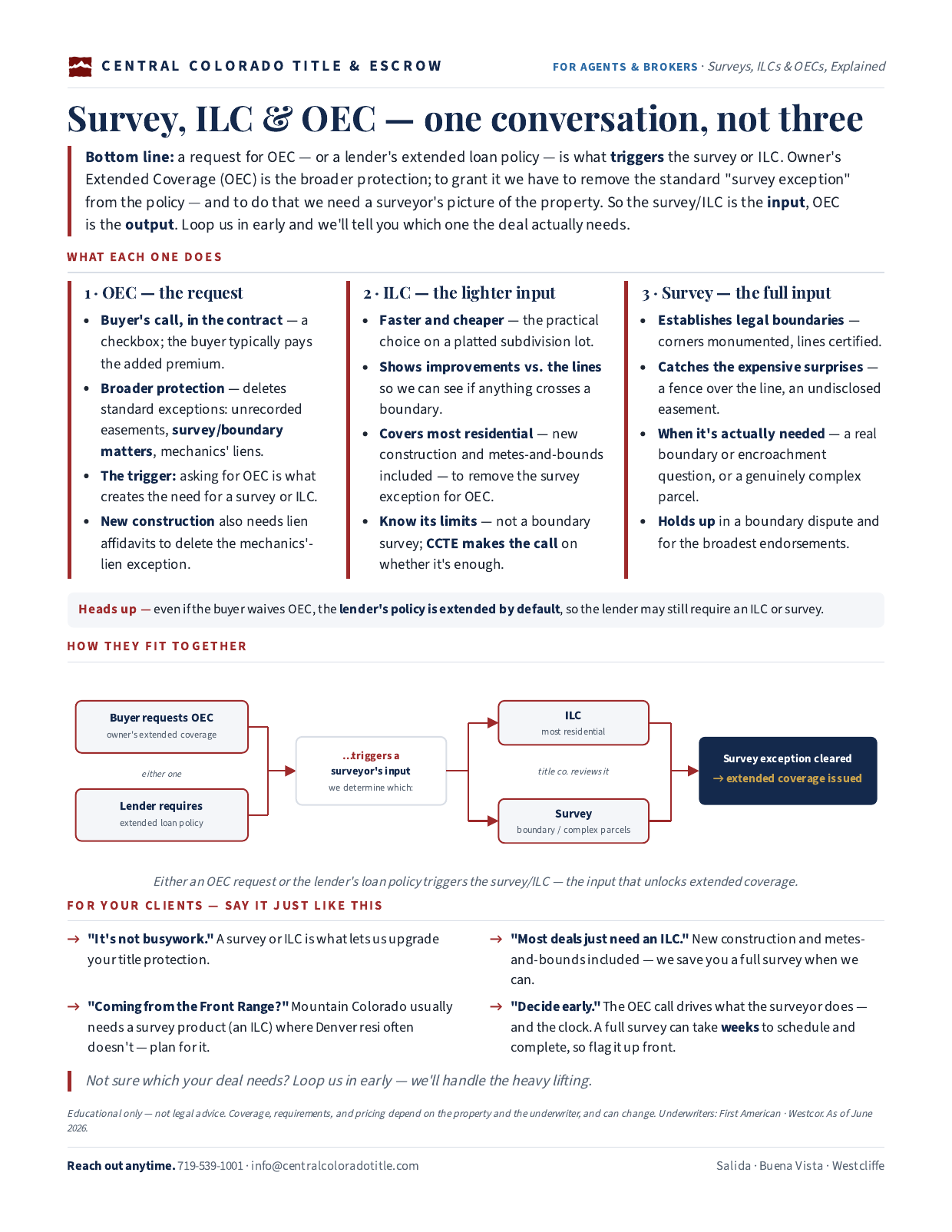
A request for Owner’s Extended Coverage — or a lender’s extended loan policy — is what triggers the survey or ILC. The survey or ILC is the input; OEC is the output. Loop us in early and we’ll tell you which one the deal actually needs.
Owner’s Extended Coverage (OEC) is the broader protection — and asking for it is what creates the need for a survey or ILC. To grant OEC we remove the standard “survey exception” from the policy, and to do that we need a surveyor’s picture of the property. So the survey or ILC is the input; OEC is the output.
What each one does
OEC — the requestThe buyer’s call, written into the contract; the buyer typically pays the added premium. It deletes standard exceptions — unrecorded easements, survey and boundary matters, mechanics’ liens. Asking for OEC is what creates the need for a survey or ILC. (New construction also needs lien affidavits.)
ILC — the lighter inputFaster and cheaper, and the practical choice on a platted subdivision lot. Shows improvements against the lines so we can see if anything crosses a boundary. Covers most residential — but it’s not a boundary survey, and CCTE makes the call on whether it’s enough.
Survey — the full inputEstablishes legal boundaries — corners monumented, lines certified. Catches the expensive surprises, like a fence over the line or an undisclosed easement. The right call for a real boundary question, a complex parcel, or the broadest endorsements.
Heads up. Even if the buyer waives OEC, the lender’s policy is extended by default — so the lender may still require an ILC or survey.
Either an OEC request or the lender’s loan policy triggers the survey/ILC — the input that unlocks extended coverage.
For your clients — say it just like this
“It’s not busywork.”A survey or ILC is what lets us upgrade your title protection.
“Most deals just need an ILC.”New construction and metes-and-bounds included — we save you a full survey when we can.
“Coming from the Front Range?”Mountain Colorado usually needs a survey product where Denver residential often doesn’t — plan for it.
“Decide early.”The OEC call drives what the surveyor does — and the clock. A full survey can take weeks to schedule and complete.
Common questions
What’s the difference between an ILC and a survey?
An ILC (Improvement Location Certificate) is faster and cheaper and shows where improvements sit relative to the boundary lines — enough to remove the survey exception on most residential files. A full survey monuments the corners and certifies the legal boundaries, which is what you want for a real boundary dispute or a complex parcel. An ILC is not a boundary survey, and CCTE makes the call on whether it’s enough.
Does the buyer need OEC on a cash deal?
OEC is the buyer’s optional call on a cash deal. But on a financed deal the lender’s loan policy is extended by default, so even if the buyer waives OEC, the lender may still require an ILC or survey.
How early should I flag this?
On day one. The OEC decision drives what the surveyor does and how long it takes — a full survey can take weeks — so deciding up front keeps your closing date realistic.
Educational only — not legal advice. Coverage, requirements, and pricing depend on the property and the underwriter, and can change. Policies underwritten through First American and Westcor (WLTIC). As of June 2026.